Ozone-Class, Without the Gas
The same oxidation, a simpler system.
Ozone is a powerful oxidant at 2.07 V and a mainstay of advanced water treatment for taste, odor, color, and micro-pollutant destruction. Its drawback is the system around it: ozone must be generated on site from oxygen or air, dissolved into water through a contactor, and its off-gas destroyed — an energy-intensive train with real capital, maintenance, and safety overhead. And once generated, ozone dissipates quickly and leaves no residual, so downstream protection has to come from a second chemical.
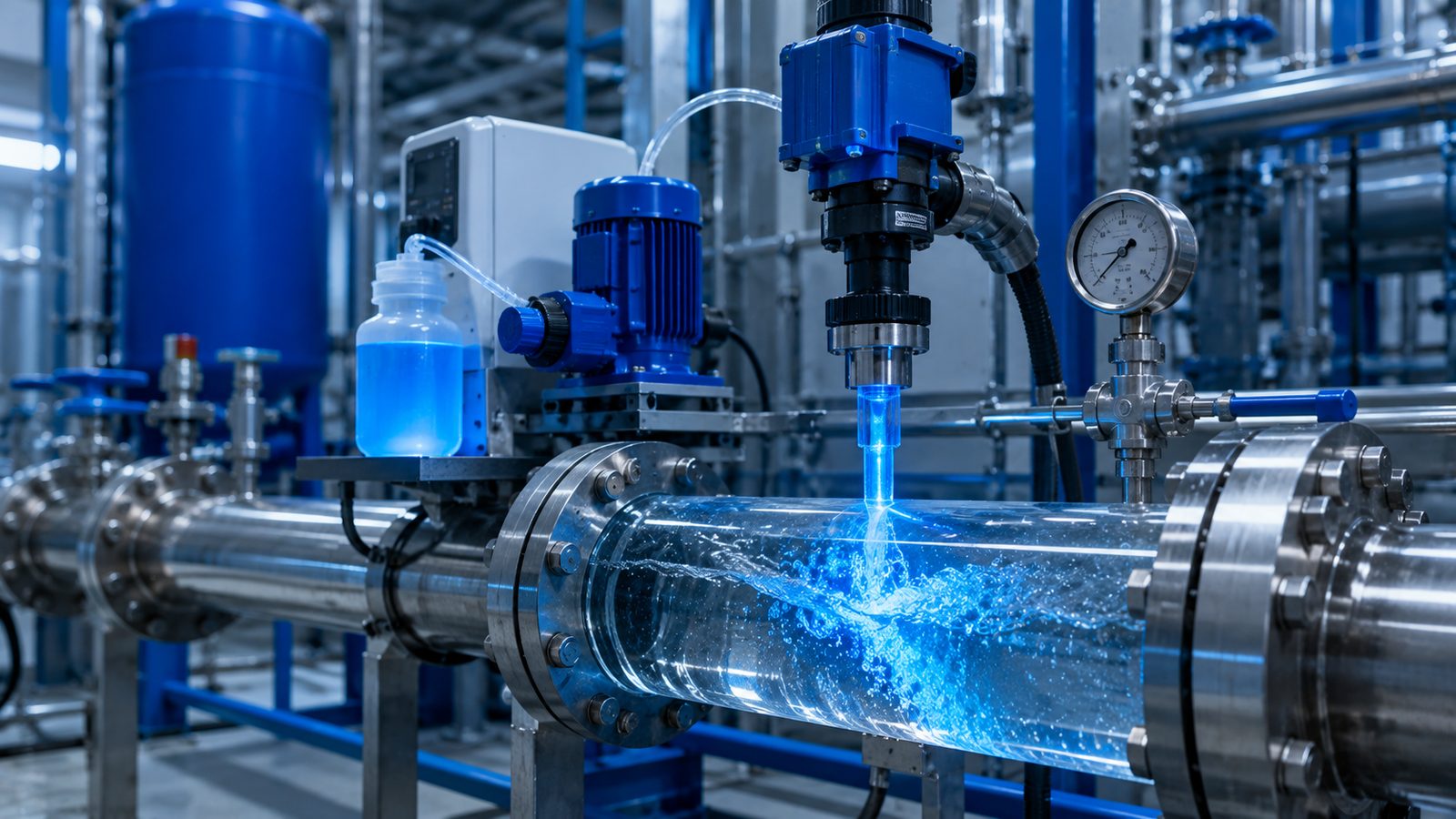
Mineral oxychloride delivers ozone-class oxidation — an effective potential of 2.8–2.9 V, near-equal to and even above ozone — but from a stable, pourable liquid. It is described as “ozone-class oxidation without dissolving a gas in water.” The weakly bound mineral–oxygen complex releases reactive oxygen species (including the hydroxyl radical, at 2.80 V) on contact, with no generator, contactor, or off-gas system to build and operate.
A residual ozone cannot leave
Because the reaction is effectively catalytic and the mineral-oxide by-products are mildly biocidal, mineral oxychloride leaves a measurable ORP residual that resists recontamination — something ozone, by its nature, cannot provide. This matters wherever downstream protection is needed, such as zebra and quagga mussel control, where ozone-class oxidation with a lingering residual is the advantage.
At a fraction of the cost
The practical result is cost. For equivalent oxidation, mineral oxychloride runs at less than 1% of the cost of a conventional ozone system — largely by eliminating the capital and energy of generating and dissolving a gas. It also integrates as an enhancement to existing ozone systems, improving performance while lowering demand. Dosing is verified by ORP: roughly +600 mV for a disinfection barrier, +700 mV for a 6-log kill in under 10 seconds.