


Metal Removal

Heavy-metal programs that lower dissolved copper and zinc, convert hexavalent chrome to trivalent, and bring difficult municipal and industrial effluent below stringent discharge limits.

Approved, certified & independently validated

UC DavisUniversity of WashingtonSpecial Pathogen LaboratoryMontana State UniversitySawtooth Ag ResearchGreenAgri SolutionsSouthern California EdisonGoleta Water District

Field Results

Measurable metal reduction.

94%Dissolved copper removed
70%Dissolved zinc removed
<1.4 ppbEffluent copper (limit 3.1 ppb)
Cr⁶→Cr³Hexavalent chrome converted
Dissolved metal treatment

Meet discharge limits without rebuilding your plant

Jenfitch metal-removal programs lower dissolved copper and zinc, convert hexavalent chrome to trivalent, and reduce other heavy metals in wastewater — helping plants hold NPDES limits by adding targeted chemistry rather than making wholesale process changes.

See the copper-removal study
Dissolved copper in wastewater

Case Study — Sierra Foothills, N. California

From over-limit to non-detect.

A full-scale municipal wastewater plant in the Sierra foothills of Northern California was exceeding its 3.1 ppb dissolved-copper discharge limit, with influent copper ranging from 28 to more than 70 ppb. A Water-Effect Ratio study confirmed the limit applied.

Over a one-year full-scale trial, Jenfitch dosed JC 9830 — a metal precipitant that forms copper sulfide — at 10 mg/L into the aeration-basin discharge, paired with JC 1687, a cationic coagulant, at 10 mg/L at the secondary-clarifier inlet. The result: 94% of dissolved copper and about 70% of dissolved zinc removed, effluent copper below 1.4 ppb, and non-detect (<0.5 ppb) results in other trials.

Discuss a metals program

Trial Data

Copper and zinc removal, sampled through the year.

Full-scale trial, Northern California WWTP. JC 9830 @ 10 mg/L + JC 1687 @ 10 mg/L. Source: Jenfitch case study.
Sample dateInfluent Cu (ppb)Effluent Cu (ppb)Cu removalZn removal
Mar 11352.094.3%68.9%
Mar 15281.694.3%79.8%
Mar 30581.497.6%76.0%
Aug 16463.891.7%56.3%
All effluent copper results held at or below the 3.1 ppb discharge limit, with several trials reaching non-detect at <0.5 ppb.

The Chemistry

Why sulfide precipitation beats hydroxide.

Hydroxide is amphoteric

Metal hydroxide is amphoteric — it re-dissolves at both low and high pH, so removal is only reliable in a narrow window (the optimum for copper sits around pH 8.1). It also generates excessive, hard-to-dewater sludge and can be blocked entirely by natural chelating agents in the water.

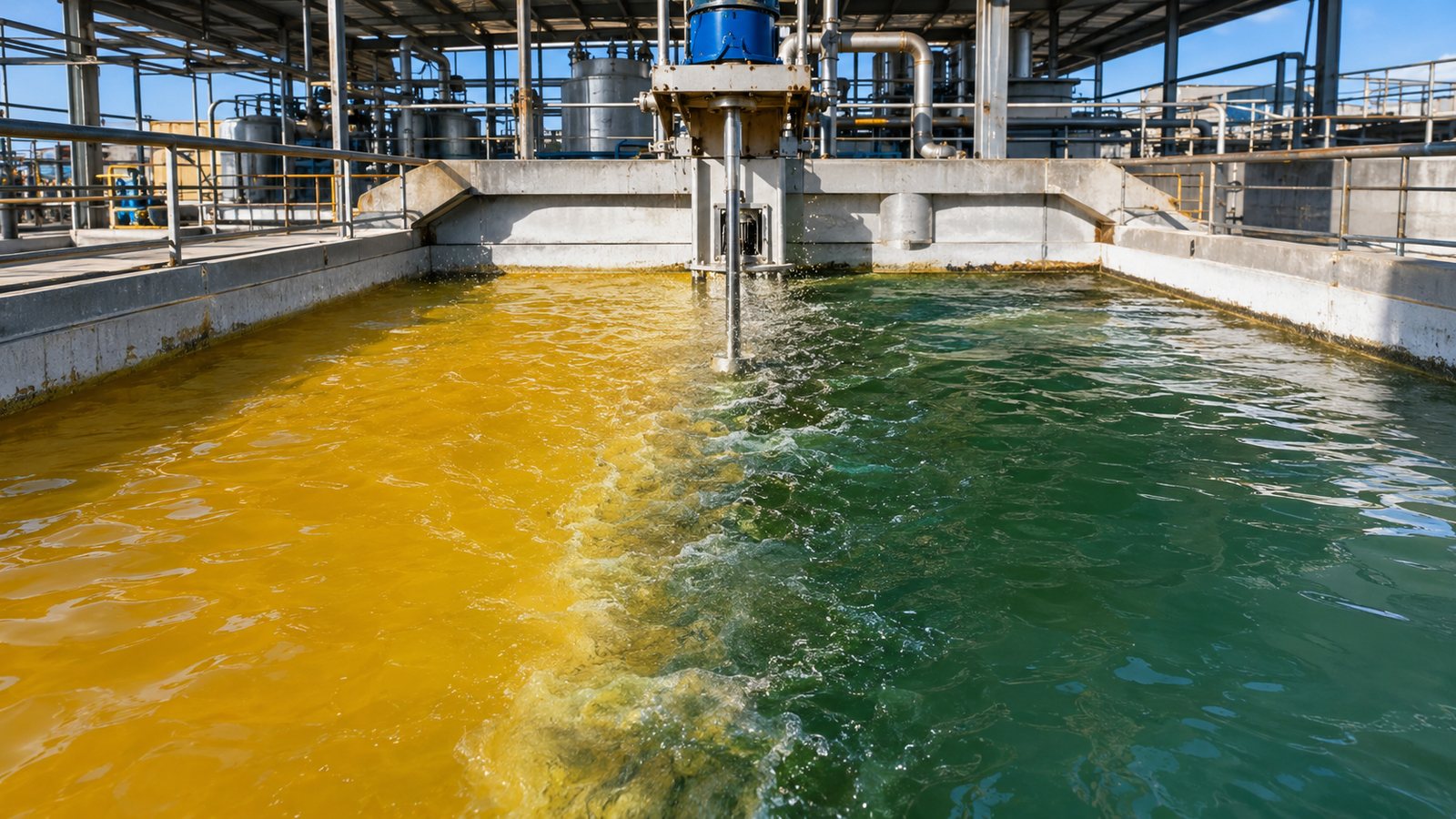
Sulfide is robust

Copper sulfide precipitates across a broad pH range, has far lower solubility, and drops out as a dense, easy-to-dewater sludge — delivering higher removal and working even where chelating agents defeat hydroxide precipitation. That is why JC 9830 forms a sulfide rather than a hydroxide.

i

Hexavalent chrome, made safer

The same program reduces toxic hexavalent chrome (Cr⁶) to the far less hazardous trivalent form (Cr³), which then precipitates and is removed with the other metals.

Applications

Metals we help you control.

The Two Products

A precipitant and a coagulant, working together.

JC 9830

Metal precipitant

Forms an insoluble metal sulfide that drops dissolved copper, zinc, and other heavy metals out of solution across a broad pH range.

  • Dosed at 10 mg/L into the aeration-basin discharge
  • Denser, lower-solubility precipitate than hydroxide
  • Works where chelating agents block hydroxide removal
JC 1687

Cationic coagulant

Neutralizes particle charge and builds a dense, fast-settling floc so the metal-sulfide precipitate captures cleanly in the clarifier.

  • Dosed at 10 mg/L at the secondary-clarifier inlet
  • Improves settling of the precipitated metals
  • Also used in Jenfitch coagulation & flocculation programs

Questions

Metal removal, explained.

How low can dissolved copper go?

In the Northern California full-scale trial, effluent copper held below 1.4 ppb against a 3.1 ppb limit, and several trials reached non-detect at under 0.5 ppb — a 94% dissolved-copper reduction alongside roughly 70% dissolved-zinc removal.

Why use a sulfide instead of a hydroxide?

Metal hydroxide is amphoteric, so it re-dissolves at low and high pH and only works in a narrow band around pH 8.1 for copper; it also makes excessive, hard-to-dewater sludge and fails when chelating agents are present. Copper sulfide precipitates over a broad pH range, has lower solubility, dewaters more easily, and works even where hydroxide precipitation is blocked.

What about hexavalent chrome?

The program reduces hexavalent chrome (Cr⁶) to trivalent chrome (Cr³), which is far less hazardous and precipitates for removal with the other metals.

Do I have to change my process?

No. The program adds two dosing points — JC 9830 at the aeration-basin discharge and JC 1687 at the secondary-clarifier inlet — so plants can hit discharge limits without wholesale process changes.

Let's talk water.

Need reliable treatment for an industrial facility, municipality, agricultural operation, or food process? We can help with quotes, safety data sheets, technical questions, and project scoping.

Contact Us